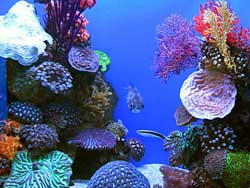
 I’m feeling a bit weird writing about underwater photography knowing that it’s freezing cold outside. Nevertheless, there are so many places where, by this time of the year, it’s warm and the water is inviting for a dive.
For those of you lucky enough to live in such a place, or as many do, spend the holidays near a water paradise, and want to record those moments not only above water but also bellow it, here are a few basic tips for underwater photography.
While some more advanced underwater photos (and of course better ones) will require specific and often expensive equipment, not to mention time spent on diving courses and all the equipment required for it, there is no reason not to try it with a more budget-friendly approach and, with time, go for the gold. But for now, let’s keep above the 10 meters (33 feet) level.
The basics: choosing and preparing the equipment
Just keep in this in mind: any beach is a highly hazardous environment for your camera. High amounts of sand, dust and moisture can quickly turn a good camera into a piece of expensive junk. Although there are available “sealing kits” that supposedly wrap your camera on a protective housing and protect it from dust and moisture, and some even allow you to take your camera underwater to low depths, personally I’ve never tried them. There is something about taking my camera underwater that puts me off. So what are the alternatives? Go for cheap and dirty: try a disposable underwater camera.
Disposable underwater cameras are simple cameras pre-loaded with film, protected inside an acrylic case. You can use them around and underwater up to a certain depth. Don’t expect “National Geographic” quality photos, but for beginners they are the best choice.
And now I’m imagining you thinking: “I’m already on the digital age, I have my workflow set, I’m used to digital processing, why would I go back to film and above all on a… ugh… disposable?”. Well, it’s your camera and it will be surrounded by water with increasing pressure as you go down. If you don’t have the money for a custom case that you’ll probably use once a year for a few shots, why not?
Choosing the right disposable camera
As with any other field in photography, there is a multitude of options available. The good news? As it is disposable, it will be cheap and the most you’ll loose if everything goes wrong is the camera and developing costs. From my personal experience, I never had a situation in which everything got ruined.
Before choosing which camera to take, there are several variables that you need to consider:
- How clear is the water
- Up to which depths do you want to dive
- Flash or no flash
 Water works as a massive light filter. The further you go from the surface, the less light you will have available and importantly, the less red light you’ll have. If you stay above the 10 meter (33 feet) level, this is not a major issue (although it’s noticeable), but if you want to go deeper you simply need to provide your own red light source. This is why photos taken with this kind of equipment tend to be blue all over. Bellow 10 meters, a camera with flash is a must, even in clear waters. This poses another problem: If there are particles in the water, the flash light will reflect on them and overexpose your photos. So, try to choose your camera based on what you want to shoot and the conditions you’ll have in the water.
This might sound too simple if you think that you are used to be worried with apertures, shutter speeds, depth of field, etc., and now you won’t have to. But realize that underwater you have many other things to be worried about: try staying still at 5 meters to correctly frame your photos in a water with just slight current and you’ll see what I mean.
As a guideline, try looking at the specs of three well-known underwater disposable cameras: Kodak Ultra Aquatic, Agfa LeBox Ocean, Fuji QuickSnap Marine.
Taking the shot
As I mentioned above, when underwater you don’t have the luxury of time to correctly frame a shot, or choose the best angle, specially if you intend to shoot wildlife. First, as as you’ll notice very very quickly, unless you take a bottle with you, you need to surface on a regular basis (yes, breathing is essential) and the cute little fish won’t stay there waiting for you. Also, looking through the camera with a diving mask on your face is much harder than it sounds. The fact that you won’t have a zoom on this camera will also require that you get as close as possible to your subject while keeping you and the subject safe.
As a good advice, if you have the time, try shooting your camera of choice on an open-air swimming pool just to get the feeling of it.
If possible, try shooting between 11 AM and 2 PM to make use of the higher levels of light penetration on the water. The angle at which light enters the water earlier or later in the day will reduce the depths at which you can shoot.
Developing the film
While the films inside these cameras have nothing special about them, you can improve the end result by taking it to a shop that specializes in underwater film processing. They are not so easy to find but the difference between the special processing and the regular film processing can have dramatic effects on the prints, making them much more vibrant and reducing the blue cast they will have otherwise.
Although this article is not extensive, I hope I managed to provide a few tips to spark your curiosity about underwater photography next time you go to the beach and improve your experience and results.
Have you tried underwater photography on a basic level? What other tips and experiences can you share with us? Leave them on the comments right bellow.
]]>
 Sometimes, after taking a shot, particularly if there are strong light sources, you may notice some weird light spots on your photo. Most certainly, they were caused by lens flare.
But what is lens flare anyway?
To understand lens flare you need to know how light works in photography. Basically, everything reflects light. You see an object as it is because it absorbs some light wavelengths and reflects others. Similarly to the human eye, a camera records the light reflected from objects and that reaches the sensor.
In a perfect situation only your photography subject should reflect light directly into the front element of your lens. But this never happens and everything that surrounds your camera is reflecting some light and some of it will indirectly enter your lens.
Lens flare is thus caused by indirect reflected light entering your lens and being scattered around your lens elements (bouncing inside your lens) until it reaches the sensor, as shown in the schematics bellow.
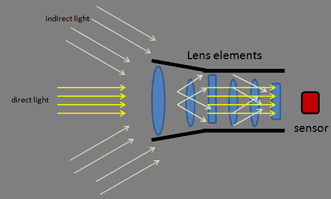
On normal conditions, the direct light is stronger than the indirect one and lens flare will be minimal and hardly noticeable. Problems arise when the indirect light comes from a strong source (like the sun). If it’s strong enough you’ll see those flare artifacts. Even when flare is not strong enough to produce artifacts, light can be broadly distributed all over the photo, reducing contrast and turning the photo pale. On a more extreme situation, lens flare can create all sorts of weird aberrations and destroy the photo completely.
The bigger the lens, the bigger the flare
 Although lens manufacturers use special coatings on the lenses (particular on the front element) to reduce light reflection and scattering while allowing light refraction, it’s impossible to eliminate it completely (light has to go through anyway).
The more glass elements your lens contains, the more pronounced lens flare will be as more surfaces are available to scatter light around. Therefore, lenses with a wide range of focal lengths are particularly affected as more elements are needed.

Intended flare
Of course that, when used correctly, this property can be applied for the photographer’s advantage. Lens flare can give a special kind of drama to the photos and in fact there are many filters out there (physical as well as software) that intend to mimic lens flare to introduce flare effects on the photos.
Reducing lens flare
The best way to reduce lens flare is by minimizing the amount of indirect light entering your lens. This is usually accomplished by shading the front element on all it’s sides with the use of a lens hood (those bulky nasty things have a use after all). Lens hoods, their design and how they work are also complex matters and will have a post of their own in the next days. Meanwhile, keep this in mind: Whenever possible, use the hood.
]]>
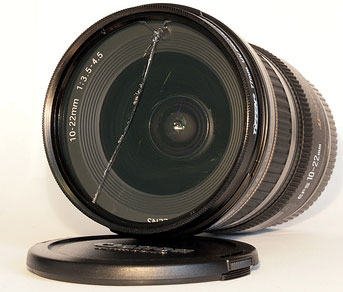 |
| Photo by Erica Marshall |
Skylights and UV filters were primarily intended to reduce the amount of UV light entering your camera. If you take a landscape photo on a sunny day with and without UV filter, you’ll probably notice that the first has a more “clear aspect” than the second, specially on distant objects (mountains, etc.). UV light can create a “blue haze” on your photos.
This was specially true for film cameras. Color film has three sensitive layers: one layer for green, one for red and one for blue. Problem is that the blue layer is somewhat also sensitive to UV light. So, the higher you are (mountain tops as an example) the more UV light will expose your film and the more bluish your photos will look. UV filters prevent this UV light from reaching your film while allowing all the other wavelengths to go through. Oh, great tool then, you might be thinking…
But there is one more important function for UV filters which is equally important whether you use film of digital, and that is PROTECTION.
Your lenses, through use, are constantly subjected to dust, scratches, humidity and so forth. Adding another layer of glass can protect your front element to a huge extent.
If you drop your lens, having a UV filter or skylight attached can mean the difference from spending another $15 on a new filter or anything from a couple hundred dollars to a couple thousand on a new lens. Is this enough to convince you?
If not I can give you my example. Some years ago, still with my film Pentax, I was just walking around the city as I sometimes like to do. My camera was hanging from my shoulder (something that I never did again) and, when climbing some stairs, to let someone pass, I stepped to the side. Result… camera hits rail, and all my blood evaporated at the sound of braking glass. I was too afraid to even look at my lens and seeing little pieces of glass on the floor didn’t help. But ok, damage had to be reviewed and I was already thinking about the price of a new lens. Fortunately the pieces of glass came from my skylight and the front element of the lens was not even slightly scratched. Having that skylight there probably saved me about $300. Even if the lens glass had not break for sure would have been scratched rendering it useless. Two lessons in it for me: carrying the camera hanging from the shoulder is dangerous and a skylight or other inexpensive glass means a huge level of protection.
Of course there are those who think that adding a $15 glass to the front of a $1000 lens can only mean a decrease in quality. My only answer is, a scratch or a broken lens definitely lowers the quality of any photo you try to make. If you are so concerned, just remove the filter before any important photo.
I have one UV filter for each lens I carry and they all live happily together.
And you? What lives at the front of your lenses?
]]>